
The freelance market continues to grow. More and more organizations are opting for flexible collaborations with specialists who temporarily share their knowledge and experience. But this growth also raises questions, especially about the DBA Act and the risk of false self-employment. What is allowed, what isn't, and how do you ensure that you, as a client, are not at risk? Let's clarify step by step.
What is the DBA Act again?
The Deregulation Assessment Labor Relations Act (DBA) is intended to bring more clarity to the cooperation between clients and freelancers. The law aims to prevent someone from working as an independent contractor while effectively having an employment relationship, known as false self-employment.
There are a few indicators that can suggest a disguised employment relationship:
The freelancer works under the direction or supervision of the client.
The freelancer is part of a fixed team or maintains fixed working hours.
The client determines exactly how the work should be executed.
The freelancer faces no entrepreneurial risk, for instance because they do not set their own rates or make any investments.
When several of these signals are present, the Tax Authorities may conclude that there is an employment agreement.
What has changed since 2025?
Since 2025, the Tax Authorities have been more actively enforcing false self-employment. While the DBA Act previously mostly existed on paper, more attention is now paid to practice: does a freelancer truly work independently, or is there effectively an employment relationship? Important to know: 2025 is a transition year. This year, the Tax Authorities focus mainly on awareness and guidance. In most cases, a warning is issued first, rather than a fine, if in doubt. Moreover, enforcement is not retroactively applied to labor relations before January 1, 2025, unless there is evidence of deliberate malice. Those who can show in 2025 that they are actively taking steps to work according to the rules, will not be subjected to infringement penalties.
Furthermore, a new bill is ready: the Clarification Assessment Labor Relations and Presumption Act (VBAR). It was submitted to the House of Representatives in July 2025, but is not yet implemented. The VBAR aims to further clarify the rules and offer more guidance on what does and does not constitute independence. In short, the Tax Authorities are paying more attention to practical situations in 2025, but offer clients room to adjust their method of collaboration step by step to the rules.
What does this mean for clients?
For many clients, the DBA Act is a tricky subject. The rules seem simple, but in practice, there is a lot of gray area. Where exactly is the line between a true independent collaboration and a situation that too closely resembles an employment relationship?
The core is simple: As a client, you can specify what needs to be done, but the freelancer decides how it is done. That sounds logical, but in practice, cooperation often goes wrong. When you, as a client, decide when, where, and in what manner someone works, you soon approach a power dynamic, which is exactly what the DBA Act aims to prevent.
To prevent your collaboration from being seen as false self-employment, it's important to make clear agreements and also secure them well in daily practice. Pay attention to the following:
Document agreements in a model contract that is approved by the Tax Authorities. This demonstrates that the collaboration meets the guidelines.
Keep the collaboration temporary and project-based. An independent contractor generally does not work structurally for one client but provides specific knowledge or capacity for a defined period or project.
Regularly evaluate. Together, determine if the agreements and practice are still aligned with the independent status. If the method changes or the project continues longer than planned, it is advisable to review the agreement again.
Allow space for entrepreneurship. A freelancer can decide how the work is executed and must have the opportunity to serve other clients as well. This confirms independence and prevents risks.
By taking these agreements seriously, you not only protect yourself as a client but also the professional you collaborate with. It ensures a fair, transparent foundation, exactly what good entrepreneurship is about.
Safe and transparent collaboration with Eleanor
The tightened DBA Act has prompted many clients to think. How do you collaborate with freelancers in a way that feels right and complies with the rules? Eleanor helps with this. The platform is designed so that freelancers and clients can collaborate safely, transparently, and in line with laws and regulations, without making it complicated. Contracts play a central role in this. At Eleanor, we find it important that every collaboration starts with clear, well-documented agreements. Therefore, we offer standard contracts that comply with the Tax Authorities' guidelines and are legally up-to-date. This way, you can be sure that everything is contractually well arranged, whether it's a small project or a large collaboration.
In addition, Eleanor ensures that the collaboration also works in practice:
Project-based collaboration: Eleanor encourages working based on concrete assignments with a clear scope and duration. This keeps the collaboration temporary and prevents it from resembling a permanent employment relationship.
Transparent communication: By managing their own hours, rates, and progress, freelancers keep it clear who is responsible for what.
Complete insight: Both the client and freelancer have insight into the agreements, payments, and documents at any time.
Eleanor closely follows developments around the DBA Act and the upcoming VBAR Act. When the rules change, we adjust our platform accordingly, ensuring you always work according to the most recent laws and regulations.
In short, with Eleanor, you not only arrange the match but everything surrounding it. Professional, transparent, and completely according to the rules. This allows you to focus on what truly counts: collaborating, growing, and moving forward.
Discover how simple collaboration can be via Eleanor.tech
Coalitieakkoord 2026: gevolgen voor zzp’ers, freelancers en opdrachtgevers

Mike
Owner

Effectief samenwerken met freelancers: zo richt je je organisatie slim in
Mike
Owner
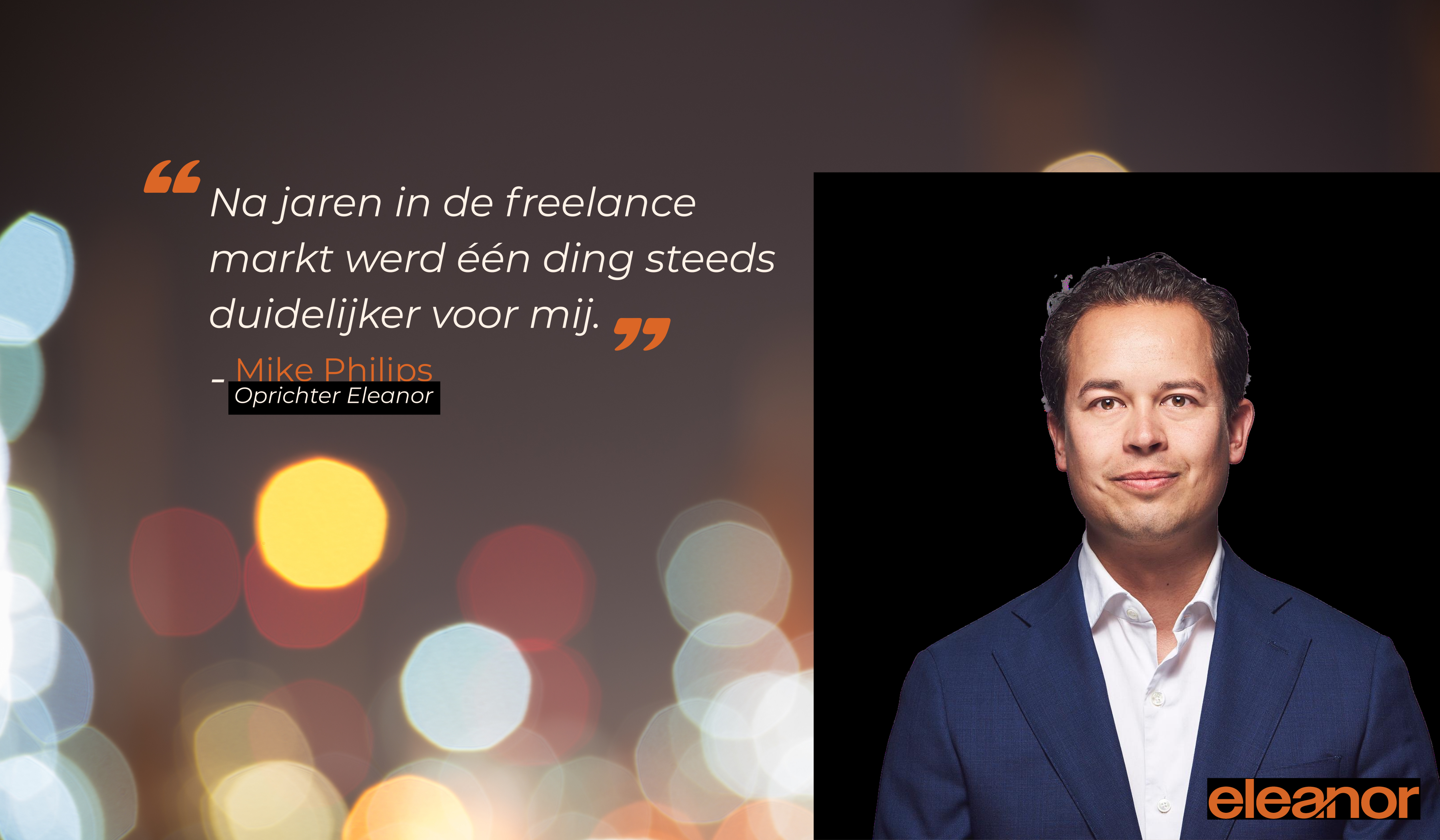
How Eleanor started – Explained by Founder Mike Philips
Mike
Owner

The power of recommendations: how to find the best freelance match as a company
Mike
Owner

Why companies should continue working with freelancers structurally
Mike
Owner

The Social Impact of Eleanor: More Than Just Freelance Matching
Mike
Owner

Trends in freelancing in 2025: what both clients and freelancers need to know
Mike
Owner

How Eleanor brings freelancers and clients closer together
Mike
Owner